
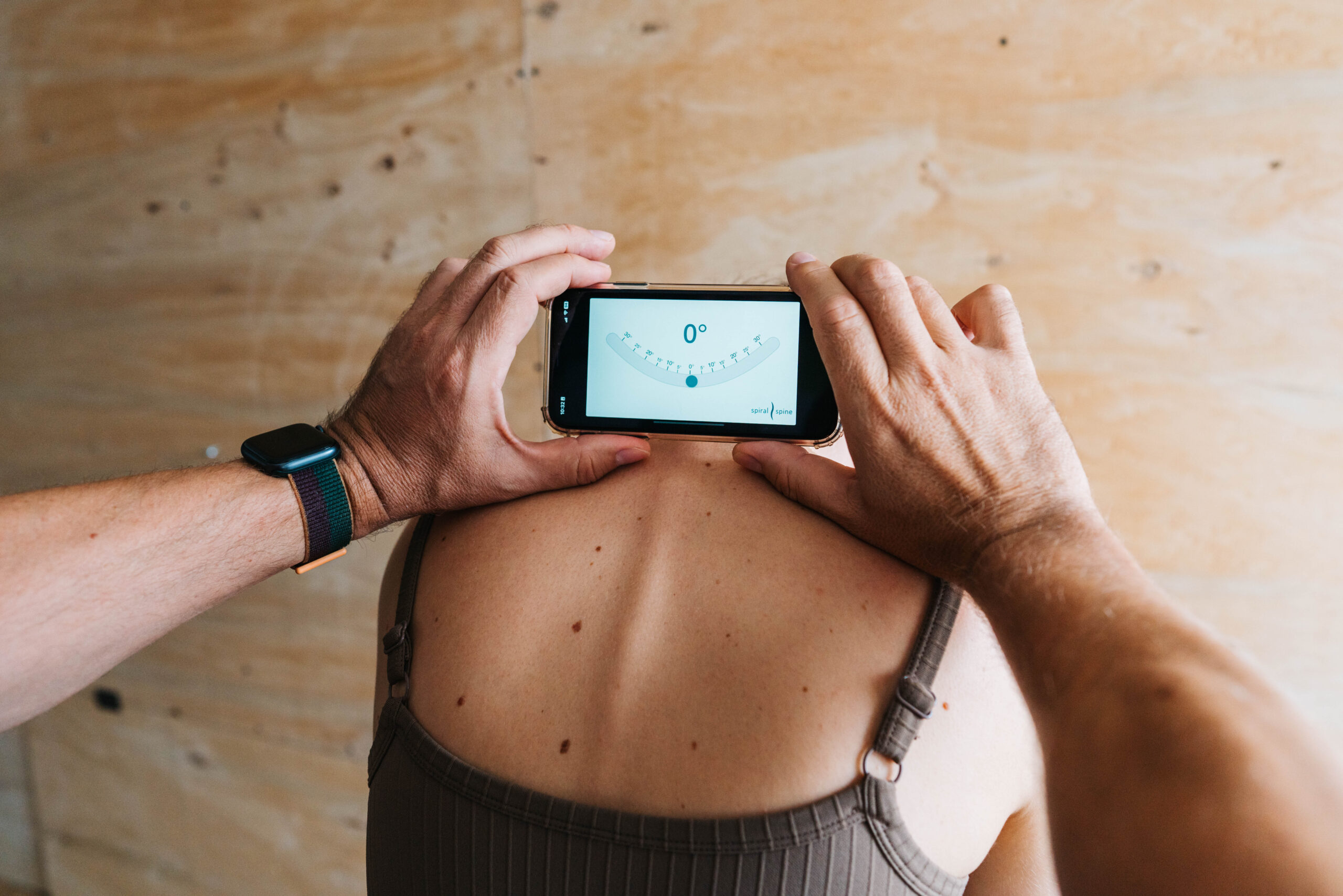
What scoliosis is and how it is classified, what the latest studies show about exercise, and where a Pilates instructor’s scope of practice ends.
Clients with scoliosis are turning up in Pilates studios across Europe in growing numbers. They arrive with a specific medical condition and with expectations they often picked up online. And they require the instructor to draw three distinctions clearly: what the current evidence supports, what it does not, and what falls outside a Pilates instructor’s scope of practice.
This article summarises what studies published in 2025 and 2026 have shown, and how those findings translate into teaching a class. Technical abbreviations are explained as they appear, and a full glossary follows at the end.
A Pilates instructor is not a physiotherapist and does not diagnose. We do not interpret X-rays, predict prognosis or comment on medical treatment. Our job is to deliver safe, targeted movement training within the plan set by a physician or physiotherapist.
That is precisely why it is worth reading the literature and continuing to study — not so we can step over the line, but so we know exactly where it lies and stay on the right side of it.
Part one: what we are talking about
What scoliosis is, and who is in front of us
True scoliosis — known clinically as structural scoliosis — is not simply a “crooked back”. It is a three-dimensional spinal deformity: a lateral deviation greater than 10 degrees of Cobb angle when viewed from behind, accompanied by rotation of the vertebrae around the vertical axis and a change in the curve seen from the side — in thoracic curves the natural arch of the thoracic spine (kyphosis) typically flattens. That rotational component is exactly why exercising in a single plane is not enough: the curve exists in three dimensions, so the correction must too.
We speak of scoliosis once the angle exceeds 10 degrees. Below that threshold we are looking at postural asymmetry — an uneven way of holding the body, not scoliosis. That distinction is worth maintaining rigorously, so we never attach a diagnosis to a client who does not have one.
Adolescent idiopathic scoliosis is the most common form: it affects roughly 1 to 3 % of children aged 10 to 16, with girls clearly predominating among the more severe curves. About 80 % of paediatric scoliosis is idiopathic — of unknown cause — and the diagnosis is reached by ruling out the alternatives.
Before going into detail, let us put the terminology in order, because in the literature and at courses these categories get mixed together and confusion follows easily. Scoliosis is classified along three separate axes, which do not exclude one another but complement each other.
- By whether the curve is fixed — structural or non-structural. This is the top-level distinction and we come to it in the next section.
- By cause — idiopathic, congenital, neuromuscular, degenerative. The table a little further down covers this axis, and every one of its types sits under structural scoliosis. A non-structural curve has causes of its own: a leg-length difference, muscle tension, a protective posture adopted because of pain.
- By the age at which it appeared — infantile (up to 3 years), juvenile (4 to 9), adolescent (10 to 17) and adult. This axis is mainly used for idiopathic scoliosis, which is why the phrase we meet most often is adolescent idiopathic scoliosis.
One client can therefore carry all three labels at once: structural, idiopathic, adolescent.
Not every lateral curve involves rotation
This is a distinction worth knowing in the studio, because it changes the entire approach to a session.
- Structural (true) scoliosis involves a lateral curve and vertebral rotation. Rotation is part of the definition — without it, we do not call it scoliosis. The curve does not disappear when the client lies down or bends forward.
- Non-structural scoliosis — also called functional scoliosis or scoliotic posture in the literature — shows only a lateral deviation without vertebral rotation. It tends to be a consequence of something else: a leg-length difference, a tilted pelvis, muscle spasm, a protective posture adopted because of pain, or long-term poor sitting. On lying down or bending forward it usually straightens out or improves markedly.
Clinically the difference is assessed with a forward bend (the Adams test): if a hump rises on one side of the back during the bend, rotation is present and the curve is structural. If the deviation disappears in the forward bend, it is more likely functional. A scoliometer measures this as the angle of trunk rotation.
A 2023 review of functional scoliosis in leg-length inequality frames it the same way: the functional curve is described as mild, non-rotational and correctable. At the same time the authors show that with a larger leg-length difference and a more pronounced sacral tilt, rotation can gradually appear — so the boundary is not absolute, and a long-standing functional curve can turn structural.
Less rotation is also seen in newly developed degenerative scoliosis in adults, where rotation at the apex of the curve is often limited — unlike a curve carried over from adolescence.
What this means for the instructor: with a functional curve we work on the cause — levelling the pelvis, releasing muscle tension, sitting and standing habits — and symmetrical exercise makes sense here. With a structural curve that is not enough, and asymmetrical work based on the curve pattern takes over. Which of the two a client has, however, is determined by a physician from an X-ray, not by an instructor at a glance.
Types by cause, and what each means for a session
| Type | What it means in the studio |
|---|---|
| Idiopathic (most common, ~80 % of paediatric cases) | This is where PSSE (scoliosis-specific exercise — explained further down) has the strongest support in the literature. We work according to the curve pattern, in cooperation with a physiotherapist or physician. |
| Congenital (a developmental vertebral malformation, rare) | The deformity is structural from birth; exercise does not change it. Associated anomalies are common — around a quarter of cases have urogenital findings and a tenth cardiac ones. Always requires medical supervision. |
| Neuromuscular (cerebral palsy, spina bifida, muscular dystrophy and others) | The goals are different: seated posture and trunk stability, breathing, function and comfort — not reducing the Cobb angle. This usually means working alongside a whole team of professionals. |
| Adult — progressed adolescent curve | A curve carried over from adolescence that continues to worsen slowly after growth ends, usually with degenerative changes alongside it. |
| Adult — newly developed, known in the literature as de novo degenerative | The Latin de novo means “anew” — the curve arose only in adulthood from wear of the discs and facet joints in a person who did not have one in youth. It tends to sit in the lumbar region with a milder angle. The work centres on pain, mobility and sagittal balance, not on the angle itself. |
The curve pattern decides what the session looks like
By the location of the apex, curves are divided into thoracic, thoracolumbar (at the junction of the thoracic and lumbar spine), lumbar and double — so-called double major, meaning two pronounced curves at once. The difference is not cosmetic — it changes the direction of self-correction, the region we direct the breath into, and which positions support the curve and which aggravate it. A right thoracic curve needs something different from a left lumbar one, and a double curve needs a combination that must not improve one segment at the expense of the other.
This is why PSSE schools work with curve-pattern classifications — the best known is the Rigo classification, which distinguishes five basic patterns. Prognosis differs too: during growth, double curves carry a higher risk of worsening than single ones, whereas after growth ends it is thoracic curves that deteriorate most.
The literature also shows, however, that the curve pattern alone does not determine whether exercise succeeds. A two-year study compared the effect of PSSE in thoracic and lumbar curves and found no significant difference in correction. Put another way: the curve pattern determines which exercises we choose — not whether the client benefits from exercising at all. The benefit is comparable whether the curve is thoracic or lumbar. So the curve pattern changes the selection of exercises, not the decision about whether to offer exercise in the first place.
What PSSE means
PSSE stands for Physiotherapeutic Scoliosis-Specific Exercises. It is not a single method but an umbrella term introduced by the international professional society SOSORT (Society on Scoliosis Orthopaedic and Rehabilitation Treatment) to cover a whole family of exercise schools.
The fundamental difference from ordinary exercise is asymmetry and individualisation. The exercises are designed around the specific curve pattern and the three-dimensional characteristics of that person’s deformity. Symmetrical core strengthening and general conditioning do not count as PSSE.
Every PSSE programme must contain four components:
- Three-dimensional self-correction. The client actively corrects in all three planes; they are not passively positioned.
- Postural correction and stabilisation. Holding the corrected position against load and through movement.
- Training in activities of daily living. Known in the literature as ADL. The correction is carried over into sitting, standing, walking and carrying.
- Client education. Understanding their own curve, the reason for the exercise and the importance of consistency.
The main schools under the PSSE umbrella are:
- Schroth — the German school, centred on rotational breathing into the collapsed regions of the ribcage.
- SEAS (Scientific Exercise Approach to Scoliosis) — the Italian school, emphasising self-correction carried into everyday movement.
- BSPTS (Barcelona Scoliosis Physical Therapy School) — the Barcelona offshoot of the Schroth method, developed by Manuel Rigo. It rests on the same principle — correction according to curve pattern plus targeted breathing — but adds its own classification of curve patterns.
- FITS (Functional Individual Therapy of Scoliosis) — the Polish school.
- Lyon, Dobomed and Side-Shift — the French, Polish and British schools.
Part two: what the studies say
Now that we know which client and which method we are discussing, let us turn to what the research shows about them: where Pilates sits within it, what determines the outcome, and which dosage has support.
Where does Pilates sit in all this?
Some review papers list Pilates alongside the schools named above. That does not mean a classical Pilates class is PSSE — and it is only honest to say so plainly.
- The classical repertoire is essentially symmetrical. In clinical studies Pilates therefore often features as the control group against which scoliosis-specific programmes are compared.
- In head-to-head comparisons Schroth performs better than general core stabilisation exercises (CSE in the literature) on Cobb angle, trunk rotation, cosmetic deformity (how the asymmetry appears outwardly), spinal mobility and quality of life. Core stabilisation, by contrast, produced greater gains in peripheral muscle strength.
- The combination has support. A published 24-week programme combining the Schroth method with Pilates tracked Cobb angle, trunk rotation, chest expansion on inhalation, flexibility and quality of life.
The overlap between PSSE and Pilates is in fact greater than it first appears. Of the four core PSSE components, three are things a well-educated Pilates instructor brings to every single class: active correction of the client in real time, education about posture and breathing, and preparation for activities of daily living. This is exactly why, in the studies discussed below, supervised programmes — those where a trained professional stood beside the client and corrected them continuously — come out far better than exercise the client performed alone at home.
And if the instructor has additionally completed specialised scoliosis training, the combination becomes a strong one — Pilates is not PSSE, but it sits close to it and works excellently in tandem with a physiotherapist’s programme.
For a scoliosis client, Pilates makes sense as a vehicle for self-correction, breathing and carry-over into everyday movement — not as a substitute for a programme led by a physiotherapist. For a class to approach PSSE principles, it has to be rebuilt around that individual’s curve pattern: asymmetrical positions, targeted breathing into the collapsed region, and self-correction carried into standing and walking.
New data: why exercising under professional supervision is decisive
If a reader takes one sentence away from this article, let it be this one: in scoliosis, exercise works when a trained professional leads it. Where clients exercised largely on their own, the effect disappeared in the studies.
This was shown by a meta-analysis published in April 2026 — a paper that statistically pools the results of several studies into a single figure. It draws on ten randomised studies, in which participants were assigned to groups at random; together they cover 600 adolescents aged 10 to 18 with Cobb angles of 10 to 45 degrees. The authors compared programmes delivered under full therapist supervision with programmes the client largely performed at home alone.
| Outcome measured | Full supervision | Hybrid / home-based |
|---|---|---|
| Cobb angle (lateral curvature from an X-ray) | SMD −0.70 | SMD −0.15 (not significant) |
| Trunk rotation — ATR (scoliometer in forward bend) | SMD −1.33 | SMD −0.13 (not significant) |
| Quality of life — SRS-22 (22-item questionnaire) | A trend towards improvement, without statistical significance | |
Source: Lee & Tak, Medicina 2026
SMD (standardized mean difference) is a common measure of effect size that allows studies using different instruments to be compared. A negative value here means improvement. As a rough guide: 0.2 is a small effect, 0.5 moderate, and 0.8 or above large.
The p-value expresses the probability that the observed difference arose by chance. A p below 0.05 is conventionally treated as statistically significant. “Not significant” does not mean the effect does not exist — it means the data could not reliably distinguish it from chance.
GRADE is an international system for rating the certainty of evidence on four levels: high, moderate, low and very low.
The difference between the supervised and hybrid groups was statistically significant for trunk rotation (p = 0.0004) but not for Cobb angle (p = 0.07). Certainty of evidence under GRADE was moderate for Cobb angle and low for trunk rotation and quality of life.
The authors stress that what matters is not the number of sessions in itself, but immediate correction, adherence monitoring and fidelity of execution — that is, whether someone is continuously correcting the execution, tracking whether the client is actually exercising, and making sure the exercise does not drift over time. This is precisely what a trained instructor can provide in a private session or a small group.
These are not groundbreaking numbers. Most of the included studies had short follow-up (up to six months), small samples, and some Cobb angle changes fall within measurement error. With clients, therefore, we talk about slowing progression — that is, the curve worsening — about controlling rotation, mobility and quality of life, not about “straightening the spine”.
Supervision and the client’s own work are not in conflict
It would be wrong to read these figures as saying home exercise is pointless. The numbers say something different: home exercise on its own is not enough. Without someone regularly correcting how the exercise is performed, the correction falls apart over time — the client keeps exercising, but is now exercising something other than what they learned.
A working model therefore stands on two legs, and both are essential:
- Regular sessions with a trained instructor. This is where the correction is built, where it gets fixed, and where the client receives feedback they cannot give themselves in a mirror. This is the engine of the whole programme.
- The client’s daily work between sessions. A short home routine and — more importantly still — a change in how the client sits at work, how they stand, how they carry a bag and how they breathe. This is exactly why training in activities of daily living is one of the four core PSSE components.
For the client this means one uncomfortable but important fact: one session a week cannot offset six days of holding the body in a way that feeds the curve. Scoliosis is not treated by a class — it is changed by the way a person uses their body throughout the day. The instructor’s job is to teach the client that, and then to make sure it does not stay confined to the studio.
In other words: the instructor is the one who sets the programme up, corrects it and keeps it alive; the client is the one who carries it out. Remove either of those two parts and the result slips away.
Exercise frequency that has support in the literature
- Frequency: most supervised programmes ran three times a week.
- Session length: 30 to 90 minutes.
- Block duration: 8 to 24 weeks, with the effect assessed at the end of the block.
- Home exercise: yes, but as a supplement to supervised sessions, not as a replacement for them.
If a client can only manage a single session a week, it is fair to tell them this is more of a maintenance and educational regime than a programme with an expected structural effect.
Part three: what this means for studio practice
Numbers alone do not change a class. This part translates them into what the instructor actually does in the next session.
Four rules that always apply
- No diagnosis, no targeted programme. A client with scoliosis who has never been examined belongs with a physician first. Without knowing the type and location of the curve we do not know which way to correct — and a wrongly chosen asymmetrical correction is worse than symmetrical exercise.
- We do not copy programmes between clients. Two people with the same Cobb angle may need exactly opposite positions.
- We do not classify clients by how their back looks. Visual assessment does not replace an X-ray, and rotation cannot be judged reliably by eye.
- Goals differ with age. In an adolescent during a growth spurt the primary goal is to prevent progression. In an adult we work mainly on pain, mobility, breathing and postural muscle endurance.
The above could be read as saying symmetrical exercise is the right answer in scoliosis. It is not. It means only that symmetry is the safer starting choice compared with asymmetry chosen blindly — it pushes nowhere, but it also moves nowhere.
Pilates does not help because it is symmetrical. In head-to-head comparisons, symmetrical core work lags behind scoliosis-specific programmes. It helps when it is led by a trained instructor who corrects continuously, works with the breath, carries the correction into the everyday, and knows how to rebuild the repertoire asymmetrically around the curve pattern. Symmetry is the starting point, not the goal.
What this looks like on specific exercises
A symmetrical exercise is one where both sides of the body do the same thing, for the same duration, under the same load. Most of the classical repertoire is exactly that. The table below shows, on three familiar exercises, where the line runs between “we are exercising” and “we are correcting”.
For illustration we take a right thoracic curve — apex on the right, so the right posterior ribcage is prominent and the left is collapsed.
| Exercise | Symmetrical version | What turns it into corrective work |
|---|---|---|
| The Hundred (mat) | Both arms pump equally, the breath goes into the whole ribcage. | The client places a hand on the collapsed left side of the ribcage and directs the breath there deliberately. The shoulders are set so the trunk is not rotated. It is not about how many beats the client completes, but whether they complete them in a corrected position. |
| Spine Stretch Forward (mat) | Flexion down the midline, both hands reaching equally far, both sitting bones equally weighted. | The hand on the convex side moves slightly forward, rotating the ribcage back into correction. The forward bend stops where the correction starts to be lost — not where the range ends. |
| Footwork (Reformer) | Both feet on the footbar in the same position, equal force through both legs. | Checking whether the client pushes harder through one leg and whether the pelvis lifts on one side. Sometimes one sitting bone is propped. Here we are not correcting the curve — we are removing an input that feeds it from below. |
The difference also shows in what counts as success. In the symmetrical version, success is ten clean repetitions. In the corrective version, success is five repetitions through which the client held the correction — and the instructor saw it and confirmed it.
The classical repertoire already contains several asymmetrical exercises — Mermaid, Side Bend, Snake and Twist, the side-lying series. Even those are not corrective in themselves: what matters is which side is worked, how many times, and with what breath. And that information has to come from the curve pattern, not from the order of the repertoire.
These examples are illustrative. Specific modifications belong in a programme the instructor sets up after consulting the client’s physiotherapist or physician.
Why Pilates is the right environment for these clients
Pilates offers precisely the environment in which everything said so far can actually be carried out. If we summarise what a scoliosis client needs, each requirement has its own tool in a Pilates studio.
| What the client needs | What Pilates provides |
|---|---|
| Correction in all three dimensions, not just sideways | Precisely defined supported positions in which the trunk can be set and then held under load |
| Breath directed into a specific region of the ribcage | Breath work is built into the method from the first minute; it is not a bolt-on discipline |
| Work based on the curve pattern, that is, asymmetrically | Springs and apparatus allow resistance to be applied unevenly and adjusted in small increments |
| Someone correcting continuously | The studio is a place where the instructor sees the client — and in a small group or private session has time to respond in real time |
| Carry-over of the correction into the everyday | The method is built around how a person uses the body, not around repetition counts |
The upshot: Pilates is not an alternative to PSSE and it is not a treatment for scoliosis. It is an environment that can be the strongest possible vehicle for this work — but only on two conditions. The instructor must know which curve they are working with, and the client must know what to do outside the studio. If either is missing, what remains is good, safe, but non-specific exercise: it will not harm the client, but it will not reach the curve either.
The second condition — what the client does outside the studio — is a matter of agreement with them. The first — that the instructor knows which curve they are working with — is a matter of education.
What specialised scoliosis training adds
The gap between an instructor who works with a scoliosis client carefully and intuitively, and one who has completed specialised training, is large in practice — and the client feels it in every session.
What such training specifically adds:
- They can read a report from a physician or physiotherapist. The curve pattern, its apex and its direction are not abstract terms to them but information from which a session can be built.
- They can determine the direction of correction. Without that, all that remains is symmetrical exercise — and a wrongly chosen asymmetry can make the curve worse.
- They can direct the breath where it needs to go. Expanding the ribcage into the collapsed region is a skill learned through guidance and feedback, not from a video.
- They can adapt the equipment. Spring tension, propping, asymmetrical support on the Reformer or Cadillac — all of it is a tool of correction, not merely a question of comfort.
- They know where their scope of practice ends. They recognise the situations that belong with a physician, and can raise them with the client without needless alarm.
Put differently: specialised training does not move the instructor closer to the role of a physiotherapist. It moves them towards being a reliable partner for both the physiotherapist and the client — someone who keeps the clinical work going between appointments and does not undo it with well-meant but wrongly chosen exercise.
How to talk about this with a client
The phrases in the right-hand column are not off-limits out of modesty. They are misleading — and when a client discovers they do not match reality, they lose trust not only in the instructor but in the method itself.
| Accurate and defensible | Misleading |
|---|---|
| “The goal is to slow the curve from worsening, improve trunk rotation, breathing and how you feel in everyday life.” | “We’ll straighten your spine.” |
| “For this to mean anything we need at least two to three months of consistency. Then we’ll reassess.” | “You’ll see results after five sessions.” |
| “This complements what your physician or physiotherapist has prescribed. I’m happy to be in touch with them.” | “This will replace your rehabilitation.” |
| “Part of the work is on you. One session a week won’t offset six days of posture that feeds the curve.” | “Just come to your sessions and don’t worry about the rest.” |
| “That’s outside my scope, but I can point you to the right person to ask.” | Estimating prognosis, interpreting an X-ray, or opinions on brace-wearing schedules. |
Conclusion
If a reader takes a single thing away from this article, it is the finding of the 2026 meta-analysis. Where a trained professional stood beside the client, both the curve angle and trunk rotation improved. Where the client exercised largely alone, the effect was lost.
What is decisive, then, is neither the method nor the choice of exercises. It is an educated person who sees the client, corrects them, and keeps them working over time — together with a client who changes how they use their body throughout the day. That is exactly what a Pilates studio can offer and what no app or video can replace.
Three things follow that are worth carrying away:
- An instructor’s education is not an add-on but a condition of the outcome. Without knowing the curve pattern and the direction of correction, a session stays safe but non-specific.
- The client has to be a partner, not a recipient. One session a week does not offset the rest of it. The instructor’s job is to change how the client uses their body all day long.
- Name things accurately. Promise slower progression, better breathing, less pain and more function. Do not promise a straightened spine. Accuracy is what makes us a credible partner for the physician and for the client alike.
Where to learn this
Working with a client who arrives with a medical context rests on three things: a thorough grasp of anatomy and biomechanics, command of the full repertoire across every type of apparatus, and the ability to read professional literature well enough to tell what is evidenced from what is not.
Fitlates Akadémia is the only comprehensive Pilates teacher training programme in Slovakia that prepares candidates for NPCP certification (National Pilates Certification Program). NPCP is accredited by the NCCA (National Commission for Certifying Agencies). The academy is a partner of PEI (Pilates Education Institute), based in the USA.
The programme is taught in English, since the NPCP examinations themselves are held in English. Training covers Mat, Reformer, Chair, Trapeze Table (Cadillac), Ladder Barrel and Spine Corrector, together with anatomy, biomechanics and Pre-Pilates preparation.
Shorter courses and workshops
The comprehensive programme is not the only route. The academy also runs shorter thematic courses — some for instructors, others open to the public as well. They include:
- Breathing — how to work with the breath consciously, and why it is the first step with most clients rather than an afterthought.
- Osteoporosis — what is and is not advisable with reduced bone density, how to adapt the repertoire, and where the safety limits lie.
- In preparation: specialised courses on working with the scoliosis client — the very subject of this article — and on working with clients during and after cancer treatment.
For an instructor who has already completed the comprehensive programme, these courses are a way to extend their reach into a specific client group. For everyone else they are a good first encounter with how Fitlates Akadémia works.
Comprehensive Pilates Teacher Training with NPCP preparation
Full programme content, the module schedule and entry requirements are on the programme page.
All courses and workshops: pilatesakademia.sk
Glossary of abbreviations
The abbreviations below appear in professional literature and at international courses. We do not use them when speaking with clients.
| PSSE | Physiotherapeutic Scoliosis-Specific Exercises — physiotherapeutic exercises specific to scoliosis. |
| SOSORT | Society on Scoliosis Orthopaedic and Rehabilitation Treatment — the international society issuing guidance on conservative, i.e. non-surgical, treatment of scoliosis. |
| SEAS | Scientific Exercise Approach to Scoliosis — the Italian PSSE school. |
| BSPTS | Barcelona Scoliosis Physical Therapy School — the Barcelona offshoot of the Schroth method. |
| FITS | Functional Individual Therapy of Scoliosis — the Polish PSSE school. |
| ADL | Activities of daily living. |
| CSE | Core stabilization exercises. |
| ATR | Angle of trunk rotation — measured with a scoliometer in a forward bend. |
| SRS-22 | A 22-item quality-of-life questionnaire from the Scoliosis Research Society. |
| ROM | Range of motion — the available movement at a joint. |
| RCT | Randomized controlled trial — the most reliable study design for a single intervention. |
| SMD | Standardized mean difference — a measure of effect size. |
| CI | Confidence interval — usually 95 %. |
| GRADE | A system for rating the certainty of evidence on four levels. |
| NPCP | National Pilates Certification Program. |
| NCCA | National Commission for Certifying Agencies — the accrediting body for the NPCP programme. |
| PEI | Pilates Education Institute — a US-based education provider and partner of Fitlates Akadémia. |
| ACSM | American College of Sports Medicine — publishes exercise guidance and an annual trends report. |
Sources
Lee S-Y, Tak J-Y. Effect of Supervised Versus Hybrid Delivery of Physiotherapeutic Scoliosis-Specific Exercises in Adolescents with Idiopathic Scoliosis: Systematic Review and Meta-Analysis. Medicina 2026;62(4):768.
Rrecaj Malaj S, Aliu M, Murtezani A, Kovačič T. The Evidence of Physiotherapy Scoliosis-Specific Exercises in Treating Secondary Postural Deviations in Mild and Moderate Idiopathic Scoliosis: A Scoping Review. Journal of Functional Morphology and Kinesiology 2026;11(3):288.
Negrini S et al. 2016 SOSORT guidelines: orthopaedic and rehabilitation treatment of idiopathic scoliosis during growth. Scoliosis and Spinal Disorders 2018;13:3.
Rrecaj-Malaj S et al. Outcome of 24 Weeks of Combined Schroth and Pilates Exercises on Cobb Angle, Angle of Trunk Rotation, Chest Expansion, Flexibility and Quality of Life in Adolescents with Idiopathic Scoliosis. Medical Science Monitor Basic Research 2020;26:e920449.
American College of Sports Medicine. 2026 Worldwide Fitness Trends: Future Directions of the Health and Fitness Industry. ACSM’s Health & Fitness Journal, November/December 2025.
Fitlates Akadémia — Comprehensive Pilates Teacher Training with NPCP preparation. Na Riviére 2, Bratislava — Karlova Ves, Slovakia.
This article is informational and educational in nature. It does not replace medical examination, diagnosis or a physiotherapy plan. For health concerns, please consult a physician or physiotherapist.